Realms of Ruin
1–5 players explore a modular octagon-tile realm, close Rift Gates, and work through a growing pool of quests before the Doom Tide swallows the Realms whole. The Doom Track never stops climbing.
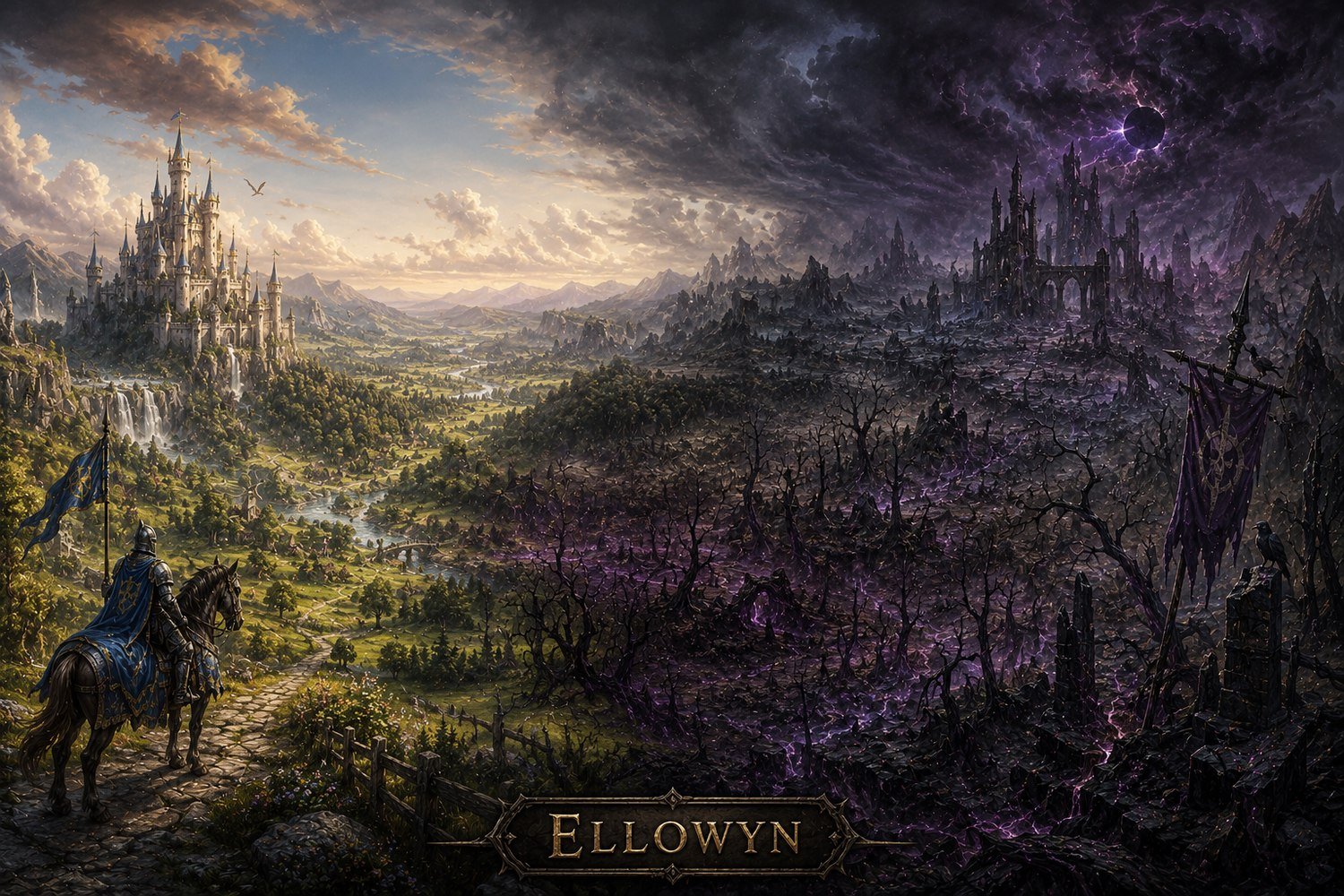
Was it always this way? The old songs remember Ellowyn as whole and untroubled, when a traveler could walk through the realm and never once look over their shoulder. Then the Rifts opened. No one still living agrees on why, and by the time anyone thought to ask, and it no longer mattered — the Blight had already torn through from the other side, and it was too late.
Doom climbs, indifferent to good intentions. The Blight is not a monster. It is what becomes a monster. It moves over the land as blood washes through flesh. A slow, patient accounting, until the tally comes due and the Realm answers for it. Rift Gates that will not seal, the ground too corrupted to hold a crop, things that used to be have not yet finished forgetting what once was. At the center of it, in a court built from grief, Malachar the Undying waits the way only the patient dead can wait.
It is now a time for Heroes. Not chosen, not owed anything by a world that has already taken plenty from them — just present, and willing to mend what now lays open. Quests wait to be finished, one revealed at a time. Rift Gates wait to be sealed — every last one of them, if the heroes are thorough enough, and patient enough, and willing to see it through. And somewhere past all of it, in a court built from grief, something ancient still waits, patient as it has always been, whether or not anyone ever comes looking.
What This Game Is
Heroes explore a modular octagon-tile board, fight monsters, and close Rift Gates. Completing the session's quest pool unlocks the Final Quest — closing every Rift Gate on the board, for now, with more Final Quests planned — and completing it wins the game outright. Malachar the Undying and the Ashen Court are a separate, optional challenge; defeating him is never required to win. The Doom Track is a shared pressure clock — every Fate token drawn, every overcrowded space, every Short Rest pushes it higher. Tone is high fantasy and dark, not horror — restrained, literary.
How a Round Works
Each player takes 2 actions for their hero, plus any Free Actions (Spell, Ultimate) their resources allow. Players may act in any order, but each must finish their turn before the next player goes.
Monsters activate by ACT number, lowest first (Boss = 1, Elite = 2, Common = 3). The Travelling Merchant moves 1 space along the connected map's perimeter.
Every hero draws 2 Fate tokens, one after the other, resolving each icon in drawing order — Doom, Rift, Monster, Encounter, Blank, or Reckoning.
Refresh all exhausted abilities. Optional Level Up (3 gold per level) or Short Rest.
Core Rules at a Glance
STR melee attacks · AGI ranged attacks, stealth · INT spellcasting, resisting Corruption, social · WIS Banish — closing Rifts and clearing Doom tokens. Dice pools use standard d6s; 5 or 6 is a success.
Every Realm tile has 1 center space + 4 perimeter spaces. The center can hold a Doom token like any other space. Rift Gates always sit on the center.
Each token occupies one space (max 1 per space). If a tile's 5 spaces are all occupied, the Doom Track advances by 1 instead of placing another token.
Heroes on a space pool WIS and roll together. Clear Doom for each success. On a Rift Gate specifically, 4+ successes closes the Rift entirely.
Corruption reaching 6 is not a defeat condition — it never removes a hero. Reaching 6, just like Corruption dropping to exactly 0, triggers drawing a Dark Pact: a blind-drawn card, held face-down, that resolves when a Reckoning Fate token is drawn or its holder takes additional Corruption, and they roll a 1.
Win by completing every quest in the session's pool, then completing the Final Quest. Lose if the Doom Track reaches 13, or if all heroes are Vanquished at the end of the Hero Phase.
Explore the Realms
Every section below is generated from the same data that drives the printable cards — nothing here is out of sync with the physical components.